
Visiting the magnificent temples in Thailand is an unforgettable experience. But for a first-timer, it can also feel a little intimidating. What should you wear? How should you act? What if you need to ask a question? Don’t worry—we’ve got you covered.
To make Thai temple etiquette clear and simple, let’s follow two friends on their first visit together. Anna has traveled in Thailand before, and she’s showing her friend Sara, a first-time visitor, around a beautiful local temple, or wat. We’ll walk through their journey from start to finish so you can see exactly what to do and say, and when.
Before You Go: What to Wear
Proper attire is the first and most important step in showing respect. The basic dress code for visiting temples in Thailand is to dress modestly. This means keeping your shoulders and knees covered.
Avoid wearing:
- Sleeveless tops or tops that expose the shoulders (such as tank tops or tube tops).
- Crop tops or anything that exposes your midriff
- Shorts, miniskirts, or anything that ends above the knee
- Tight-fitting clothing like leggings
- Sheer or see-through fabrics
- Swimwear or beach cover-ups
While some temples might offer a scarf or sarong for rent, it’s always best to arrive prepared. The rules for visiting temples in Thailand can vary slightly from place to place, so always follow any posted signs.
As they get ready to leave their hotel, Sara holds up a sleeveless top. “Anna, is this okay for the temple?”
Anna shakes her head gently. “Almost—we need to cover our shoulders there. Why don’t you wear that shirt with the long sleeves instead?”
At the Main Hall Entrance: Shoes Off and a Polite Wai
When you arrive at the temple grounds, you don’t need to take your shoes off immediately. You’ll typically only remove them before entering the main chapel or other designated sacred buildings. Look for a sign or a shoe rack, which is a clear indicator of what to do.
Many temples also have a raised wooden threshold at the entrance to buildings. It’s important to step over this threshold, not directly on it, as it holds spiritual significance.
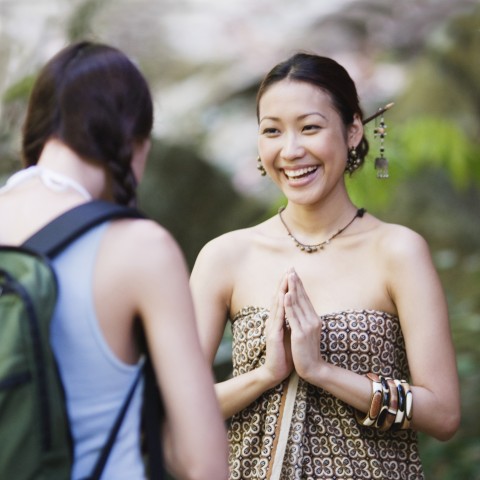
As you enter, it’s customary to offer a polite greeting called the wai. The height and depth of the wai actually change depending on who—or what—you’re greeting:
- Standard wai (for staff and laypeople): Press your palms together at chest level, fingertips near your chin, and give a slight bow of your head. Use this when greeting temple attendants or fellow visitors.
- Higher, deeper wai (for monks or Buddha images): Raise your palms so your fingertips touch between your eyebrows, and bow your head and shoulders a little lower and longer. Use this when greeting a monk or paying respect to a Buddha statue.
At the entrance to the main hall, Sara sees a large shoe rack. “Oh, should we take our shoes off here?”
Anna nods, already slipping off her sandals. “Yep, this is the spot.” She sees a temple attendant nearby, gives a gentle, standard wai—palms at chest height—and says, “สวัสดีค่ะ” (sà-wàt-dii khâ) “Hello.”
Here are a couple of phrases that will come in handy:
- สวัสดีค่ะ / สวัสดีครับ (sà-wàt-dii khâ / sà-wàt-dii khráp) “Hello.” (female / male speaker)
- มีที่วางรองเท้าไหมคะ / ครับ (mii thîi waang raawng-tháao mǎi khá / khráp) “Is there a place to leave my shoes?” (female / male speaker)
Inside the Main Hall: How to Sit, Point, and Take Photos

Once inside, the atmosphere is calm and peaceful. The key is to maintain that sense of tranquility. Here are a few essential rules for what to do inside a Thai temple:
- Keep your voice low. Speak in a quiet, hushed tone and make sure your phone is on silent.
- Never point your feet. In Thai culture, feet are considered the lowliest part of the body. Never point them toward a Buddha image, a monk, or another person. When sitting on the floor, tuck your feet behind you or to the side.
- Point respectfully. Avoid pointing at a Buddha statue or other sacred object with a single finger. Instead, gesture with your right hand, palm facing up.
- Follow photography rules. Many temples have signs indicating where you can and cannot take photos. Never take pictures of people while they are worshipping without their explicit permission. It’s also important not to pose disrespectfully with Buddha images (e.g., turning your back to them for a selfie) or climb on any statues or sacred structures.
Inside, Sara sits down and stretches her legs out in front of her, pointing her feet directly at the main Buddha statue.
Anna gently touches her arm. “Hey, try to sit with your feet tucked to the side, like this,” she whispers, demonstrating the correct posture. “It’s more respectful here.”
Talking to Temple Staff or a Monk: Useful Thai Phrases
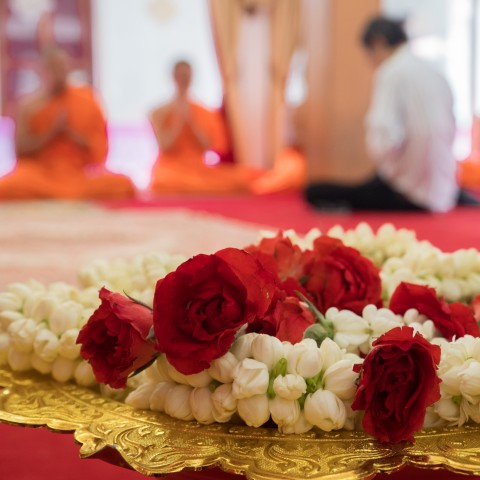
Don’t be afraid to ask questions, but always do so politely. Using the correct polite particle is key: female speakers generally use khâ (ค่ะ) for statements and khá (คะ) for questions, while male speakers generally use khráp (ครับ) for both.
Here are five phrases you can use to communicate respectfully:
- ขอโทษค่ะ / ขอโทษครับ (khǎaw-thôot khâ / khǎaw-thôot khráp) “Excuse me.”
- ถ่ายรูปที่นี่ได้ไหมคะ / ครับ (thàai rûup thîi-nîi dâai mǎi khá / khráp) “Can I take a photo here?”
- ทำบุญที่ไหนได้คะ / ครับ (tham bun thîi-nǎi dâai khá / khráp) “Where can I make an offering?”
- อันนี้เรียกเป็นภาษาไทยว่าอะไรคะ / ครับ (an-níi rîiak bpen phaa-sǎa-thai wâa à-rai khá / khráp) “What is this called in Thai?”
- ขอบคุณค่ะ / ขอบคุณครับ (khàawp-khun khâ / khàawp-khun khráp) “Thank you.”
A quick note on pronunciation:
Thai is a tonal language, so getting the tone right can change the meaning of a word entirely. Reading the tone marks above is a good start, but to actually use these five phrases with confidence, listen to how a native speaker says them—check an audio pronunciation resource, such as ThaiPod101’s audio lessons or a Thai dictionary app with built-in audio, before your visit. For more practice asking someone to slow down, see our lesson “How Long Can We Stay in Thailand?”, which includes ช่วยพูดช้า ๆ ได้ไหมคะ / ครับ (“Could you speak more slowly?”) in a travel dialogue.
As Anna and Sara continue through the main hall, Sara notices a beautiful floral offering and decides to ask a staff member about it. She gestures toward it with her whole hand, as Anna showed her, and asks, “Excuse me, what is this called?”
Anna whispers to her, “Remember to add khá at the end!”
Sara smiles and turns back to the staff member. “ขอโทษค่ะ อันนี้เรียกเป็นภาษาไทยว่าอะไรคะ” (khǎaw-thôot khâ. an-níi rîiak bpen phaa-sǎa-thai wâa à-rai khá?)
One final, very important piece of etiquette: do not touch a monk. This is especially true for women, who should also avoid handing anything directly to a monk. Instead, place the object down for the monk to pick up.
Quick Fixes: Common Temple Mistakes to Avoid
This might seem like a lot to remember, but most of it is common sense. Here’s a quick checklist of things to avoid to ensure your visit is respectful:
- Wearing revealing clothing (shoulders and knees should be covered).
- Entering a chapel or prayer hall without removing your shoes.
- Stepping directly on a raised door threshold.
- Pointing your feet toward a Buddha image or a monk.
- Touching a monk. Women should also avoid handing objects directly to a monk.
- Speaking loudly or letting your phone make noise.
- Taking photos where it’s prohibited or photographing worshippers.
- Climbing on, sitting on, or touching sacred structures or statues.
Remember, Thai people are generally very welcoming and understanding. As long as you are making a sincere effort to be respectful, a small mistake is unlikely to cause offense. Always pay attention to posted signs and observe what the locals are doing.
Why These Customs Matter
Understanding a bit of the “why” behind these rules can make them easier to remember. Thai temples are not just tourist attractions; they are active places of worship and community centers. The customs surrounding temple visits are all rooted in showing respect—for the Buddha, for the monks who dedicate their lives to their practice, and for the local people who come to pray and find peace. Following this etiquette is a simple way to honor the culture and sanctity of the space you are visiting.
Thai Temple Visit Cheat Sheet: What to Wear, Do, and Say
Ready for your visit? Here’s a quick recap you can screenshot for easy reference.
- Dress: Keep your shoulders and knees covered with modest, non-revealing clothing.
- Entrance: Take shoes off where indicated. Step over the threshold, not on it. Greet staff with a standard wai (palms at chest height); use a higher, deeper wai for monks or Buddha images.
- Inside: Keep your voice low and phone silent. Sit with your feet tucked away from Buddha images and monks. Follow all photography rules.
- Monks and staff: Do not touch monks. Female speakers generally use khâ for statements and khá for questions; male speakers generally use khráp for both.
- Useful Thai:
- สวัสดีค่ะ / ครับ (sà-wàt-dii khâ / khráp) — “Hello.”
- ขอโทษค่ะ / ครับ (khǎaw-thôot khâ / khǎaw-thôot khráp) — “Excuse me.”
- ถ่ายรูปที่นี่ได้ไหมคะ / ครับ (thàai rûup thîi-nîi dâai mǎi khá / khráp) — “Can I take a photo here?”
- ทำบุญที่ไหนได้คะ / ครับ (tham bun thîi-nǎi dâai khá / khráp) — “Where can I make an offering?”
- อันนี้เรียกเป็นภาษาไทยว่าอะไรคะ / ครับ (an-níi rîiak bpen phaa-sǎa-thai wâa à-rai khá / khráp) — “What is this called in Thai?”
- ขอบคุณค่ะ / ครับ (khàawp-khun khâ / khàawp-khun khráp) — “Thank you.”
Quick Self-Check: Test Your Temple Etiquette
Match each situation below to the correct action or phrase. Answers are listed underneath.
Situations:
- Before you leave the hotel, what should you check about your outfit?
- At the entrance to the main hall, what two things should you do?
- You want to ask what an offering is called in Thai. What do you say?
- You want to ask if you can take a photo. What do you say?
- You’re sitting on the floor facing a Buddha image. What should you do with your feet?
Answers:
- Make sure your shoulders and knees are covered.
- Remove your shoes, and greet any staff with a polite wai.
- อันนี้เรียกเป็นภาษาไทยว่าอะไรคะ / ครับ (an-níi rîiak bpen phaa-sǎa-thai wâa à-rai khá / khráp) — “What is this called in Thai?”
- ถ่ายรูปที่นี่ได้ไหมคะ / ครับ (thàai rûup thîi-nîi dâai mǎi khá / khráp) — “Can I take a photo here?”
- Tuck them behind you or to the side, never pointing them at the Buddha image.
With these simple guidelines and phrases, you’re ready to explore Thailand’s beautiful temples with confidence and respect.
Further learning:
Once you’re comfortable with these basics, a great next step is our lesson “You’re Not from Thailand, Are You?”, where you’ll learn to introduce yourself and share where you’re from.